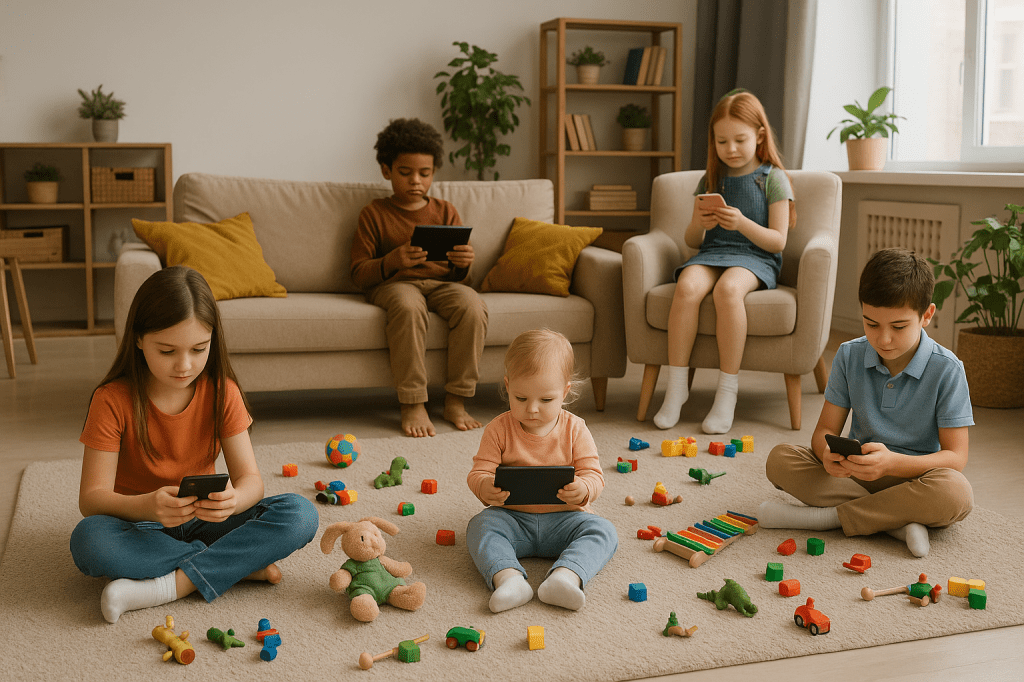
It’s no secret that screens have become part of everyday life — from smartphones and tablets to televisions and laptops. For many parents, the question isn’t whether children will encounter screens, but “how much is too much?”.
As a physician, I often hear concerns like: “Is screen time harming my child’s brain development?” The short answer is — it depends on age, content, and context. Let’s explore what science says.
How Screens Influence the Developing Brain
In the first few years of life, a child’s brain grows faster than at any other time — forming millions of neural connections every second. These connections are built through real-world experiences: looking at faces, listening to voices, talking, touching, playing, and interacting with people.
Studies show that When screen time replaces too much of this hands-on, face-to-face learning, it can affect how certain brain networks develop.
- A 2019 NIH study found that children aged 3–5 who used screens for more than 1 hour a day had lower white matter integrity in brain areas related to language and literacy skills (Hutton et al., JAMA Pediatrics, 2019).
- Research also suggests that high screen exposure before age 2 is associated with delayed language development and reduced parent–child interaction (Linebarger & Walker, Journal of Applied Developmental Psychology, 2005).
However, not all screen time is harmful. Interactive, educational, and co-viewed content — especially when parents engage with their child — can actually support learning. The key is quality over quantity.
What Science Recommends
Here’s what pediatric experts, including the American Academy of Pediatrics (AAP), suggest:
- Under 18 months:
Avoid screen time except for video chatting with family. Babies learn best through human interaction, not digital media (AAP, 2016). - 18–24 months:
If you choose to introduce screens, pick high-quality educational content and watch together to help your child understand what they see (AAP, 2016). - 2–5 years:
Limit screen time to about one hour per day of quality programming. Co-watch and talk about what’s happening on the screen — it turns passive watching into active learning (WHO, 2019). - 6 years and older:
Encourage balance — ensure adequate sleep, physical activity, and offline play. Establish “tech-free zones,” like bedrooms and dining tables.
Why Balance Matters
Healthy development depends on a rich mix of activities:
- Physical play strengthens coordination and attention.
- Reading and storytelling build language and imagination.
- Social interaction nurtures emotional and cognitive growth.
When screens displace these activities, it can impact emotional regulation, attention span, and sleep patterns. Conversely, when screens are used purposefully — for learning, connection, or creativity — they can enhance growth.
Practical Tips for Parents
- Create “screen-free zones” — like mealtime and bedtime.
- Be a role model. Children mirror adult habits — show balanced tech use.
- Use parental controls and review apps or shows before allowing access.
- Encourage creative activities — drawing, music, outdoor play. Talk, read, and play with your child daily.
- Co-view and discuss. Ask questions like “What did you learn?” or “What do you think will happen next?”
Summary
Screens are part of our world — and they can coexist with healthy development when used thoughtfully. The goal isn’t to eliminate technology, but to help children build healthy habits and strong minds.
As parents, you don’t need to fear technology — just guide it wisely.
Because no screen can replace the power of your voice, your presence, and your connection.
References
- Hutton, J. S., Dudley, J., Horowitz-Kraus, T., DeWitt, T., & Holland, S. K. (2019). Association Between Screen-Based Media Use and Brain White Matter Integrity in Preschool-Aged Children. JAMA Pediatrics, 173(3), 244–250.
- American Academy of Pediatrics Council on Communications and Media. (2016). Media and Young Minds. Pediatrics, 138(5), e20162591.
- World Health Organization. (2019). Guidelines on physical activity, sedentary behaviour and sleep for children under 5 years of age.
- Linebarger, D. L., & Walker, D. (2005). Infants’ and Toddlers’ Television Viewing and Language Outcomes. Journal of Applied Developmental Psychology, 26(5), 465–483.
- Radesky, J. S., Schumacher, J., & Zuckerman, B. (2015). Mobile and Interactive Media Use by Young Children: The Good, the Bad, and the Unknown. Pediatrics, 135(1), 1–3.
 Little Care Corner
Leave a comment